

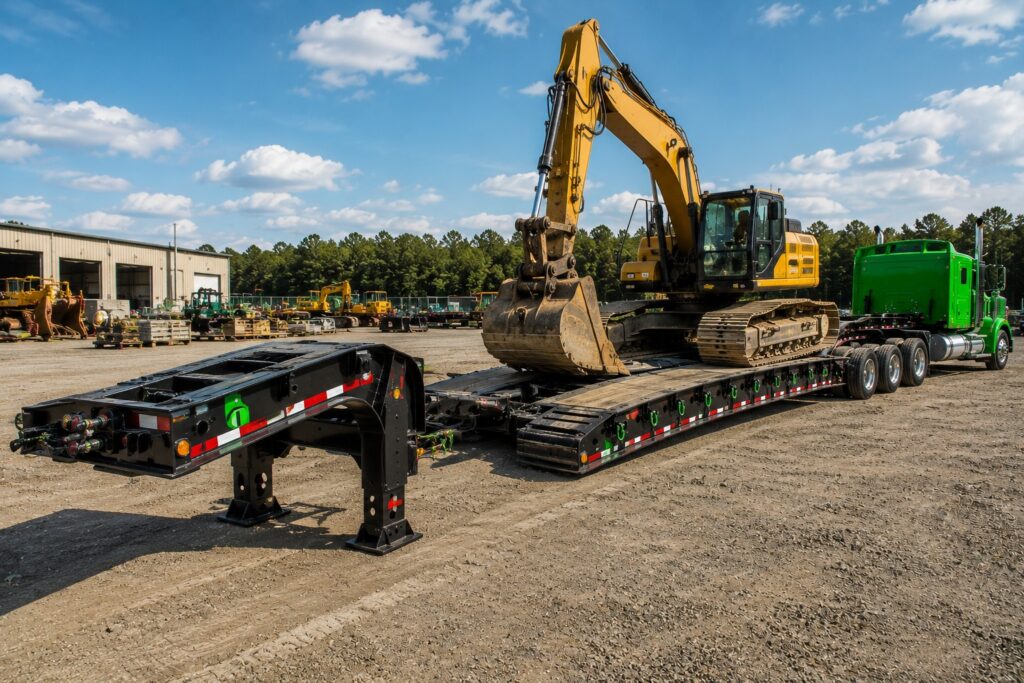
When choosing an RGN trailer for long-haul freight and heavy loads, focus on capacity, axle setup, well length, deck height, gooseneck type, loading process, and legal route limits. An RGN, or Removable Gooseneck trailer, works best for tall, heavy, and self-propelled equipment that needs a low deck and front loading access.
The right RGN-style trailer should match your cargo, tractor, routes, and loading routine. A trailer that is strong on paper can still be the wrong choice if the well is too short, the neck is hard to detach, or the axle setup does not match the freight.
What is an RGN trailer?
An RGN trailer is a lowboy trailer with a removable front gooseneck. When the neck detaches, the front of the trailer lowers to the ground and works like a ramp. This lets operators drive heavy equipment directly onto the deck.
RGN trailers are common for excavators, bulldozers, loaders, cranes, farm equipment, industrial machinery, and other oversized freight. They are especially useful when cargo is too tall for a standard flatbed trailer or step deck trailer.
Why is weight capacity the first thing to check?
Weight capacity is the first thing to check because heavy freight can quickly exceed the rating of the wrong trailer. Look at overall capacity, concentrated load capacity, axle ratings, tire ratings, and the trailer’s empty weight.
Do not only ask, “How much can the trailer carry?” Ask, “How much can it carry in the space where my equipment actually sits?”
A machine with tracks or a narrow base can place a lot of weight in one area. That is called concentrated load. For heavy equipment, concentrated capacity often matters as much as total capacity.
How many axles do I need?
The right axle setup depends on cargo weight, route rules, and how the load spreads across the trailer. A two-axle RGN may work for lighter heavy-haul jobs. Heavier loads may need three axles, a flip axle, a booster, or a multi-axle configuration.
More axles can help spread weight and meet legal road limits. But more axles also add cost, weight, maintenance needs, and reduced turning limits. For long-haul work, the best setup is not always the largest one. It is the one that gives you enough legal capacity without making every trip harder and more expensive.
Should I choose a hydraulic or mechanical gooseneck?
A hydraulic gooseneck is usually better for frequent loading, heavy equipment, and long-haul work where speed matters. It detaches and reconnects faster than a mechanical neck. It also makes loading easier when the trailer handles different types of freight.
The main issue is tractor compatibility. A hydraulic neck usually needs a wet kit, which supplies hydraulic power from the tractor. If your tractor does not have one, some setups use a pony motor to power the hydraulic system.
A mechanical gooseneck is simpler and often cheaper. It can be a good choice if you load less often or want fewer hydraulic parts to maintain. However, it usually takes more time and effort to detach and reconnect.
How important is well length?
Well length is very important. The well is the main lower-deck section where most heavy equipment is stored. If the well is too short, your equipment may not fit correctly. If it is too long, you may carry extra trailer weight you do not need.
Many RGN trailers have main deck or well lengths in the mid-20-foot to near-30-foot range, though exact specs depend on the trailer model. For longer machines, pipe, beams, tanks, or special freight, a stretch RGN may be a better option.
Before buying, measure your most common cargo. Check overall length, wheelbase, track length, height, width, and center of gravity.
Why does deck height matter?
Deck height matters because long-haul heavy freight often has height limits. The lower the deck, the easier it is to move taller loads while staying within legal height rules.
A low deck can help with excavators, loaders, bulldozers, and other tall machines. But lower is not always better. You also need enough ground clearance for ramps, uneven job sites, railroad crossings, and road conditions.
A good RGN trailer balances low deck height with usable ground clearance.
What trailer features matter for heavy equipment?
For heavy equipment, look for features that support real loading and securement. Important features include outriggers, strong crossmembers, reinforced main beams, bucket wells, boom troughs, chain drops, D-rings, and heavy-duty tie-down points.
Outriggers help support wider machines. A bucket well or boom trough can help lower the overall height of excavators and similar equipment. Strong tie-down points are important because heavy equipment must be secured against forward, rearward, side-to-side, and vertical movement.
What should I know about long-haul use?
Long-haul work adds stress. You are not just moving a load across town. You may cross multiple states, different road conditions, weigh stations, bridges, and permit zones.
For long-haul freight, consider fuel impact, tire wear, brake life, route flexibility, dealer support, and repair access. A very specialized RGN may be perfect for one type of cargo but poor for mixed freight. If you haul different machines, choose a trailer with enough flexibility in deck length, axle options, ride height, and tie-down layout.
How do legal limits affect RGN trailer choice?
Legal limits affect every heavy-haul setup. Federal and state rules can limit gross weight, axle weight, bridge weight, height, width, and route access. Oversize and overweight loads may require permits, pilot cars, special routing, curfew rules, or extra safety equipment.
This means the trailer’s rated capacity is only one part of the answer. A trailer may be built for a heavy load, but the load still needs to be legal for the route.
For buyers, this is simple: match the trailer to the freight and the permit environment, not just the brochure number.
What tractor specs should I check?
Your tractor must match the RGN trailer. Check fifth-wheel height, kingpin setting, wet-kit needs, axle ratings, horsepower, braking system, GCWR, and turning clearance.
A hydraulic RGN may require a wet kit. A taller fifth wheel can affect deck angle and loaded height. A tractor with the wrong setup can make a strong trailer harder to use.
Before buying an RGN, confirm that the trailer and tractor work as one system.
Should brand and dealer support matter?
Yes. Brand quality and dealer support matter because RGN trailers work under heavy stress. Look for strong frame design, clean welds, parts availability, warranty support, and a dealer that understands heavy haul.
Brands such as XL Specialized Trailers, Fontaine, Globe, Cozad, Murray, Kalyn Siebert, and similar heavy-haul manufacturers are often considered because they build trailers for demanding freight. Still, the best brand depends on the exact model, specs, condition, and support behind it.
For used RGNs, inspect the neck, deck, frame, hydraulic system, pins, bushings, axles, brakes, tires, ramps, and signs of past overloading.
Final answer: what matters most when choosing an RGN trailer?
When choosing an RGN-style trailer for long-haul freight and heavy loads, prioritize these factors:
- Cargo weight and concentrated load capacity
- Axle configuration and legal weight distribution
- Hydraulic vs mechanical gooseneck
- Well length and deck height
- Ground clearance and loading angle
- Tie-down points and securement features
- Tractor compatibility
- Long-haul maintenance and parts support
- Oversize and overweight permit needs
- Brand quality and dealer support
The best RGN trailer is not just the strongest one. It is the one that carries your real freight safely, loads efficiently, works with your tractor, and keeps you legal on long-haul routes.