Semi trucks come in many configurations, but most buyers, fleet managers, shippers, and drivers need to understand the same core measurements: tractor length, trailer length, width, height, wheelbase, and payload limits. Knowing a semi truck’s dimensions helps you plan loading, routing, storage, dock access, and equipment purchases with fewer surprises. This guide explains common truck dimensions in practical terms, including how trailer dimensions affect freight planning and what to look for when reviewing semi trailer specs.
What are the dimensions of a semi truck?
A semi truck’s overall dimensions depend on the tractor style, trailer type, axle setup, and cargo configuration, but a standard tractor-trailer combination is commonly thought of as a long, high-clearance commercial vehicle designed around a 48-foot or 53-foot trailer. In practical terms, people usually discuss semi truck measurements in parts rather than as one single number because the tractor and trailer can be mixed and matched. That means the most useful answer to “what are the dimensions of a semi truck” is to look separately at length, width, semi truck height, and the trailer’s usable cargo space.
Most semi trucks are about 8.5 feet wide at the outer limit of the vehicle body, excluding certain mirrors and safety equipment. Height often falls near the 13.5-foot range for many highway tractors with enclosed trailers, though low-profile equipment, flatbeds, and specialized trailers can vary. Overall length can change significantly depending on whether the tractor has a day cab or sleeper cab and whether it pulls a 48-foot, 53-foot, or specialized trailer.
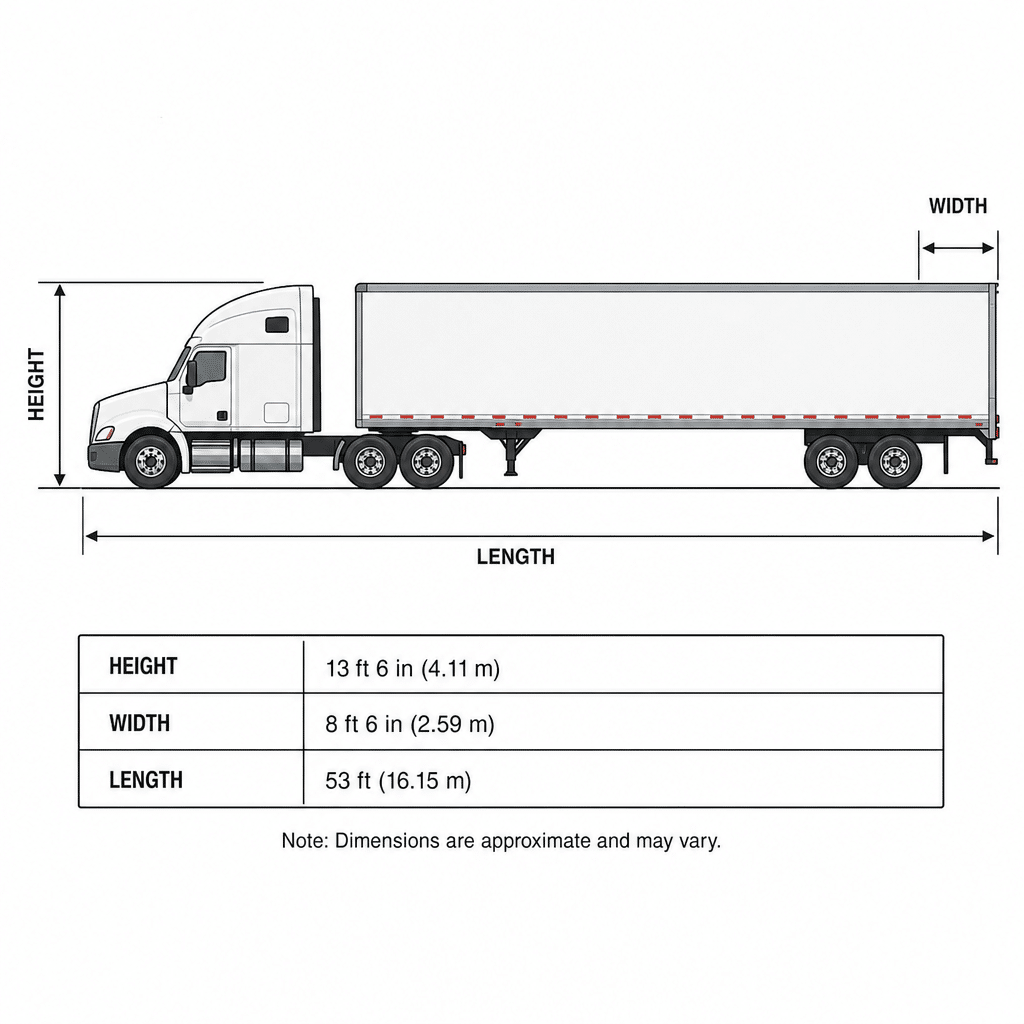
Core semi truck measurements explained
Understanding commercial truck specs starts with the major measurements that affect real-world operation. A spec sheet may list dozens of figures, but only a few determine whether a truck can fit through a gate, back into a dock, carry a specific load, or operate efficiently on a route.
Important semi truck measurements include:
- Overall length: The combined length of the tractor and trailer, which affects turning, parking, staging, and route planning.
- Trailer length: The nominal trailer size, such as 48 feet or 53 feet, used for load planning and freight quotes.
- Overall width: The side-to-side measurement of the truck or trailer body, often important for lane clearance, jobsite access, and loading docks.
- Overall height: The vertical clearance needed under bridges, warehouse doors, tree limbs, canopies, and loading structures.
- Interior cargo dimensions: The usable length, width, and height inside a dry van or refrigerated trailer.
- Deck height: Especially important for flatbeds, step decks, and lowboys because it affects load height and legal clearance.
- Wheelbase: The distance between axle centers on the tractor, influencing turning radius, ride quality, and weight distribution.
- Gross vehicle weight rating: A manufacturer’s rating related to how much the vehicle is designed to handle, not simply a physical size measurement.
These truck dimensions matter because small differences can create big operational consequences. A few inches of height can determine whether a route is safe. A few feet of trailer length can affect dock fit, turning space, and load distribution. For buyers comparing equipment, these measurements are often just as important as engine, transmission, or suspension details.
Standard tractor dimensions
The tractor, sometimes called the power unit, is the front portion of the semi truck. Its size depends heavily on cab type. A day cab is shorter and designed for local or regional work where overnight sleeping space is not needed. A sleeper cab is longer because it includes a sleeping compartment behind the driver’s seat.
Day cab tractors are often favored for city delivery, port work, construction support, and regional hauling because their shorter wheelbase improves maneuverability. Sleeper tractors are common in long-haul operations because they provide space for rest periods and extended trips. This difference in cab design can add several feet to the overall semi truck size, even when the same trailer is attached.
Tractor width is generally similar across most highway models because lane width, mirror placement, and road standards encourage consistent sizing. Tractor height varies more because of roof fairings, sleeper design, exhaust systems, tire size, suspension, and aerodynamic equipment. When checking commercial truck specs, buyers should look at the exact manufacturer data for the model and configuration rather than assuming every tractor from the same brand has identical dimensions.
What are the dimensions of a semi truck trailer?
A semi truck trailer is most commonly 48 or 53 feet long for standard freight hauling, with 53-foot trailers widely used for high-volume highway freight. The answer to “what are the dimensions of a semi truck trailer” also depends on trailer type, because a dry van, refrigerated trailer, flatbed, step deck, and lowboy all have different usable dimensions. Length may be the headline number, but width, height, deck height, and interior clearance determine what freight can actually move.
A standard enclosed trailer is typically designed around palletized freight, boxed goods, consumer products, and other cargo that benefits from weather protection. Flatbed trailers are open-deck trailers used for materials, machinery, steel, lumber, equipment, and oversized items that may need crane or forklift loading from the side or top. Select specialized trailers when standard trailer dimensions cannot safely or legally support the cargo.
For shippers, the key isn’t just the trailer’s outside size. The usable cargo area matters more. Door opening height, internal width, floor strength, axle position, and tie-down points can all affect whether a load fits and rides safely.
Common trailer types and size considerations
Different trailers are built around different freight problems. Choosing the right trailer means matching the cargo’s size, weight, loading method, and protection needs to the equipment.
Dry van trailers
Dry vans are the most familiar enclosed semi trailers on the road. They carry general freight that needs protection from weather but doesn’t require temperature control. Trailer dimensions are often described by exterior length, but interior measurements matter when planning pallets, cartons, crates, and floor-loaded freight.
A 53-foot dry van usually provides more cargo volume than a 48-foot trailer, making it useful for lighter, bulkier freight. However, more space does not automatically mean more payload. Weight limits, axle placement, and cargo balance still determine whether you can load the trailer efficiently.
Refrigerated trailers
Refrigerated trailers, often called reefers, are enclosed trailers with temperature-control equipment. Their outside freight truck size may resemble a dry van, but the refrigeration unit and insulated walls can reduce usable interior space. This makes exact semi-trailer specs especially important for temperature-sensitive cargo.
Reefers are commonly used for food, beverages, pharmaceuticals, plants, and other freight that needs controlled conditions. Because insulation and airflow are part of the design, loading patterns may need to preserve circulation space rather than filling every inch.
Flatbed trailers
Flatbeds are open-deck trailers built for freight that does not fit well inside a box trailer or needs side, top, or crane loading. If you are comparing a flatbed semi trailer for sale, the headline length is only one piece of the decision. Deck length, deck height, width, axle setup, weight rating, tie-down equipment, and condition all affect whether it fits the job.
A 53 flatbed trailer for sale may be attractive for longer materials or freight that benefits from extra deck space. Still, buyers should confirm whether the extra length fits their routes, loading areas, and freight mix. A longer trailer can add flexibility, but it may also require more turning room and careful load-securement planning.
Step deck and lowboy trailers
Step decks and lowboys are used when cargo height becomes a concern. A step deck has an upper deck and a lower main deck, allowing taller cargo to ride lower than it would on a standard flatbed. A lowboy drops the deck even farther, making it suitable for heavy machinery and tall equipment.
These trailers show that semi truck height isn’t only about the tractor or trailer. Total loaded height is often the critical number. A cargo item that looks manageable on the ground may become too tall once placed on a standard deck, so deck height should always be part of equipment planning.
Why semi truck size matters in daily operations
Semi truck size affects far more than whether a load physically fits. It shapes how a truck moves through the world. A longer combination may be efficient on open highways but difficult in crowded urban areas. A taller load may require route checks. A wider or unusually shaped load may need special planning, permits, or escorts depending on local rules and the route.
For shippers, truck dimensions influence loading dock scheduling, warehouse layout, forklift access, and packaging choices. For carriers, they affect fuel planning, driver comfort, safety margins, and maintenance needs. For buyers, dimensions help determine whether a truck or trailer will match the work instead of becoming a daily compromise.
Before booking freight or buying equipment, it helps to ask:
- What is the cargo’s length, width, height, and weight?
- Does the cargo need enclosure, temperature control, or open-deck loading?
- What is the maximum loaded height once cargo is on the deck or inside the trailer?
- Can the truck safely access the pickup and delivery locations?
- Are there bridge, tunnel, gate, canopy, dock, or road restrictions on the route?
- Does the trailer have the right floor, tie-down, axle, and door configuration?
These questions reduce guesswork. They also make conversations with brokers, dealers, dispatchers, and equipment sellers more productive.
Reading semi trailer specs before you buy
When reviewing semi trailer specs, look beyond the headline size. A listing might say a trailer is 53 feet long, but that does not tell you everything you need to know. The trailer’s year, condition, axle configuration, suspension, floor material, tire size, brakes, kingpin setting, deck height, and repair history may all matter.
For a flatbed semi trailer for sale, inspect the deck condition, rub rails, stake pockets, winches, sliding winch track, bulkhead, lights, frame, and crossmembers. For a dry van or reefer, inspect the doors, roof, sidewalls, floor, interior lining, seals, and any temperature-control equipment. If you are looking at a 53-foot flatbed trailer for sale, confirm the exact length and deck layout rather than assuming all 53-foot flatbeds are configured the same way.
A practical buying checklist includes:
- Match the trailer type to your most common freight, not just your occasional load.
- Confirm exterior and usable dimensions before committing.
- Check loaded height, especially for flatbed, step deck, and machinery hauling.
- Review axle spacing and weight distribution needs.
- Inspect structural areas carefully, including frame, floor, suspension, and coupling points.
- Consider whether your tractors, yards, docks, and routes can handle the trailer comfortably.
- Ask for documentation when available, including maintenance records and manufacturer specifications.
The best trailer is not always the biggest one. It is the one that fits the freight, the route, the loading method, and the business model.
Matching freight truck size to the job
Choose freight truck size based on the load and the operating environment. A local construction supplier may value maneuverability and open-deck access more than maximum enclosed volume. A long-haul carrier moving retail freight may prioritize cubic capacity, aerodynamic efficiency, and compatibility with standard docks. A machinery hauler may care most about deck height, weight capacity, and securement points.
This is why “standard” dimensions are only a starting point. Two trucks can both be semi trucks, yet perform very differently because one has a sleeper cab and dry van while another has a day cab and flatbed. The right choice depends on what the truck must do every week, not just what it can do once.
When in doubt, measure the freight first, then choose the equipment. This simple order prevents many expensive mistakes. It also helps ensure that the selected semi truck size supports safe loading, legal routing, and efficient delivery.
Key takeaway
The dimensions of a semi truck are best understood as a combination of tractor measurements, trailer dimensions, and loaded cargo height. Standard equipment may look similar from a distance, but small differences in length, deck height, interior space, and axle setup can change what the truck can safely and efficiently haul. Whether you are planning freight, comparing commercial truck specs, or evaluating a flatbed, dry van, or 53-foot trailer, start with the measurements that affect your actual work.
A clear understanding of semi truck measurements makes better decisions possible. It helps shippers load accurately, carriers route confidently, and buyers choose equipment that fits the job instead of forcing the job to fit the equipment.