
When buying a flatbed trailer for heavy loads, start with the real weight of your cargo, not just the trailer length or price. A trailer may look strong, but it still needs the right GVWR, axle setup, frame strength, deck design, brakes, tires, and tie-down points for the work you plan to do.
The best flatbed trailer carries your load safely and legally. It does this without stressing the truck, trailer, tires, or tie-down system.
What is the first thing to check?
The first thing to check is GVWR, or Gross Vehicle Weight Rating. GVWR indicates the maximum loaded weight the trailer can safely handle, including the trailer itself and its cargo.
Do not choose a trailer because the deck looks big enough. Choose it because the weight capacity matches your heaviest expected load with a safe margin. For example, hauling pallets of construction materials differs from hauling heavy equipment like a skid steer or compact loader.
A smart rule is simple: know the heaviest load you plan to haul, then choose a trailer rated above that number. Do not buy “just enough” trailer for heavy loads.
Why do axle ratings matter?
Axle ratings matter because axles carry and spread the weight. A trailer’s total load capacity means little if the axle group cannot legally or safely carry the cargo.
Common setups include tandem axle, spread axle, tri-axle, and multi-axle flatbeds. Tandem axles work for many heavy-duty jobs. Spread axle and tri-axle setups help with heavier loads and better weight distribution. For commercial hauling, axle spacing also affects bridge law limits and legal road weight.
This is why choosing the right flatbed trailer is not only about total weight capacity. It is also about where that weight sits.
Which types of flatbed trailers work best for heavy loads?
The main types of flatbed trailers for heavy loads are standard flatbeds, step decks, double drops, and goosenecks.
A standard flatbed trailer works well for many construction materials, steel products, lumber, pipe, machinery parts, and palletized freight. Standard flatbeds are common, flexible, and easy to load from the side, rear, or top.
A step deck, also called a drop deck, has two deck heights. The upper deck sits over the tractor area, while the lower main deck sits closer to the ground. Step decks are useful for taller loads that may exceed legal height on a standard flatbed trailer.
A double drop trailer has an even lower center deck. It works best for taller and heavier equipment that needs extra height clearance. Double drop trailers are common for specialized heavy equipment hauling.
Gooseneck trailers are common in local and regional heavy hauling. A gooseneck connection gives better stability than many bumper-pull setups and works well for equipment, farm loads, and construction jobs.
Enclosed trailers can protect cargo from weather, but they are not always the best choice for very heavy loads. If you need sides or roof protection, make sure the enclosed trailer has the correct load capacity, ramp rating, axle rating, and interior height.
Why are deck heights important?
Deck heights affect what you can haul legally. Taller loads may fit on step deck trailers or double drop trailers when they would be too tall on standard flatbeds.
For example, a 53-foot flatbed gives you long deck space, but height can still become a problem. If the cargo is tall, the lower deck of a step deck may help you stay within legal height limits. If the cargo is very tall, a double drop trailer may be the better fit.
Ask three questions before buying:
- Can the cargo fit on the deck?
- Can it stay under legal height?
- Can the weight sit safely over the axles?
If the answer is no to any of these, you may need a different trailer type.
How important is frame strength?
Frame strength is one of the most important factors when hauling heavy loads. The real strength of a trailer comes from the main beams, crossmembers, neck design, and weld quality.
Look for strong main beams, tight crossmember spacing, clean welds, and no signs of frame bending. If you buy used, inspect the trailer for cracks, rust, repairs, twisting, or uneven tire wear. These signs can point to past overloading.
Deck material also matters. Steel frames handle heavy abuse well. Aluminum flatbeds weigh less, which can help payload, but they still need the right rating for the cargo. Wood decks are common and easy to repair, but they can hide damage beneath the surface.
What is concentrated load capacity?
Concentrated load capacity refers to how well the trailer handles weight in a small area. This matters because heavy equipment does not always spread weight evenly.
A steel coil, machine base, forklift, or tracked machine can place significant pressure on a small deck area. This can bend crossmembers or damage the frame, even if the total cargo weight is under the trailer’s GVWR.
For heavy equipment, ask about point-load rating, coil package options, crossmember spacing, and reinforced deck sections. This is especially important if you haul machinery, steel, construction equipment, or dense materials.
What should I know about loading and unloading?
Loading and unloading should match the trailer and cargo. Side loading works well for steel, lumber, pipe, and palletized freight. Rear loading works well with ramps and equipment. Top loading works well when a crane or forklift loads from above.
Check ramp capacity, deck angle, ground clearance, and tie-down placement. A trailer may have enough weight capacity but still be hard to load safely. For equipment, make sure the ramps can handle the machine weight and track width.
Also check whether the trailer has enough stake pockets, D-rings, winch tracks, rub rails, and chain tie-down points. Heavy loads need secure attachment points, not just open deck space.
What brakes, tires, and wheels should I check?
Brakes, tires, and wheels can limit the whole setup. For heavy loads, the trailer needs strong brakes on the right axles, a working breakaway system, proper lights, and tires with enough load rating.
Check tire age, load range, tread condition, sidewall damage, wheel rating, and spare tire access. A trailer with strong axles but weak tires is still unsafe. Tire failure is one of the most common road problems in heavy hauling.
Should I think about the tow vehicle too?
Yes. A flatbed trailer is only one part of the system. Your truck must have enough GCWR, rear axle rating, hitch rating, brake controller support, cooling capacity, and power for the loaded trailer.
Do not forget fuel, tools, passengers, chains, binders, tarps, and extra equipment. These all add weight. If your truck is close to its limit, the trailer may not be safe even if the trailer itself is rated for the load.
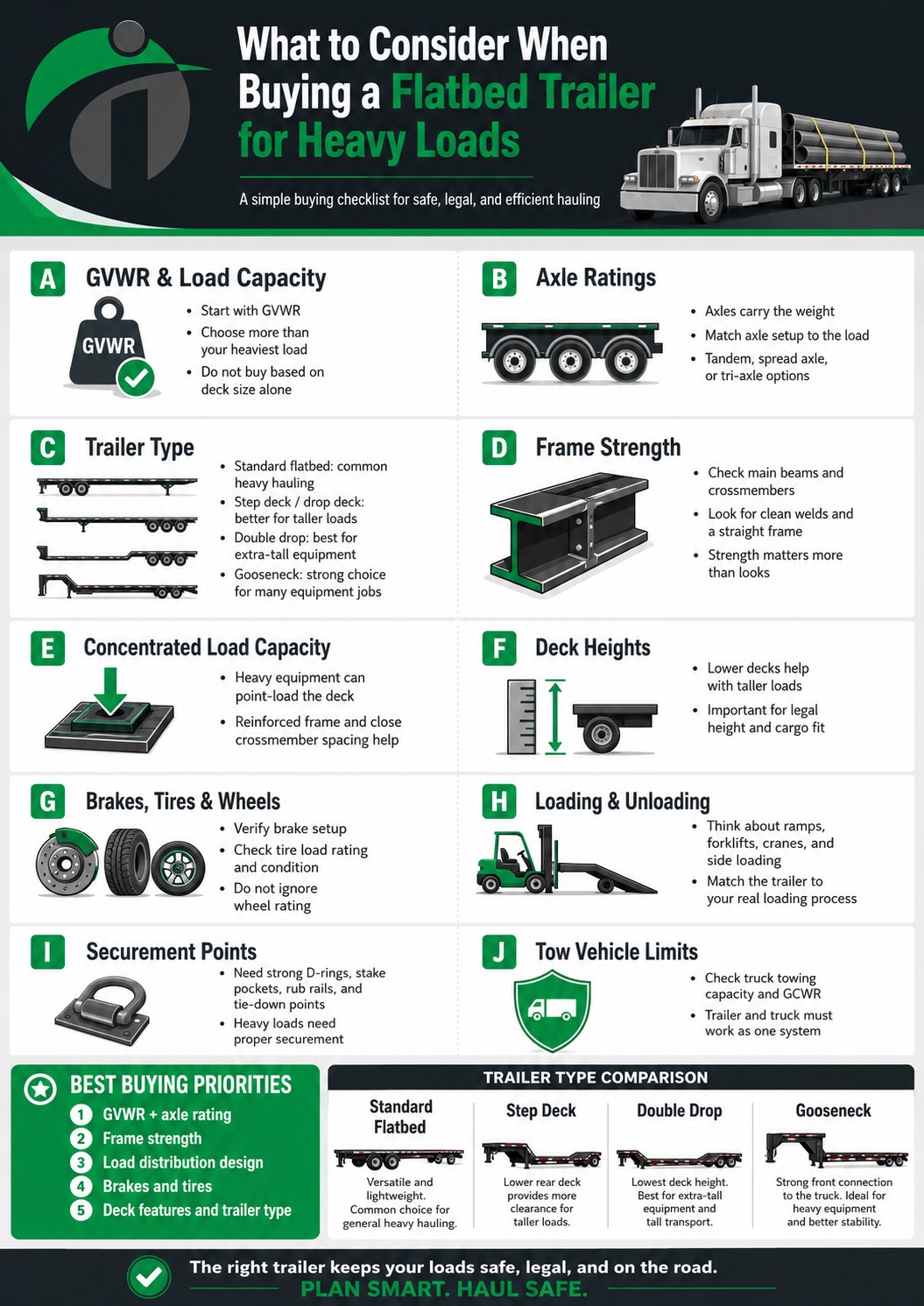
Final answer: what matters most?
When buying a flatbed trailer for heavy loads, focus on these factors in order:
- GVWR and payload capacity
- Axle ratings and axle spacing
- Frame strength and crossmember spacing
- Concentrated load capacity
- Trailer type and deck height
- Brakes, tires, and wheels
- Loading and unloading method
- Tie-down points and securement setup
- Tow vehicle limits
- Legal weight and size rules
The right trailer should match your cargo, your truck, your loading process, and your route. For heavy equipment, construction materials, taller loads, and serious commercial hauling, a cheap trailer can become expensive fast. Choose the trailer that gives you safe capacity, legal road use, and long-term durability.


