

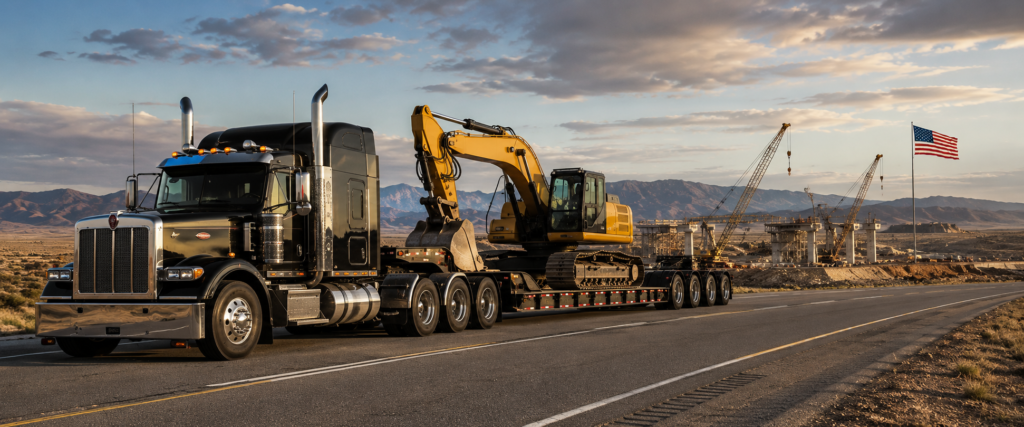
Construction sites run on movement: excavators arriving on schedule, skid steers bouncing between jobs, and dozers relocating before the next phase begins. That’s where construction equipment haulers come in—specialized machinery haulers and equipment movers that provide reliable transport solutions for everything from compact loaders to oversized earthmovers.
When done right, heavy machinery transport protects your equipment, keeps crews productive, and prevents costly compliance mistakes.

What are construction equipment haulers (and what do they actually do)?
Construction equipment haulers coordinate and execute equipment transport for jobsite machinery, often including route planning, permitting, loading, securement, escort coordination, and delivery scheduling. In practice, they’re a key part of construction logistics—especially when timelines are tight or equipment is too large for standard towing.
Typical hauling services include:
- Local and regional heavy equipment shipping
- Multi-state moves with permits and escorts
- Heavy equipment transport for rented, owned, or auction-purchased machines
- Winch-on/winch-off and forklift/crane-assisted loading
- Documentation support (BOLs, insurance, permit copies)
Internal link: Learn the basics of planning jobsite moves in Construction Logistics Planning.
Which trailer should you use? Heavy equipment transport trailer types explained
Selecting the right trailer is the fastest way to reduce risk, cost, and loading headaches. Here are the most common heavy equipment transport trailer types and where they shine.
Lowboy vs flatbed hauling: what’s the difference?
When comparing lowboy trailer vs flatbed hauling, the decision usually comes down to height, weight, and how you load.
Lowboy (lowbed) trailers
- Best for tall/heavy equipment (excavators with booms tucked, dozers, large loaders)
- Lower deck height helps with legal height limits and stability
- Often used for oversize/overweight moves
Flatbed trailers
- Versatile for pallets, attachments, small machines, and modular components
- Higher deck height can create height issues with tall equipment
- Can be cost-effective for non-oversize loads
Step deck trailer alternative to lowboy
A step deck trailer alternative to lowboy works well when a flatbed is too tall but a lowboy isn’t necessary. Step decks (drop decks) provide:
- A lower main deck than flatbeds
- Good flexibility for mid-sized machines and attachments
- Often simpler loading than deep lowboy configurations
Best trailer for skid steer (and compact equipment)
For compact equipment, the best trailer for skid steer is often:
- A gooseneck or bumper-pull equipment trailer with proper GVWR
- Enough deck length for the machine plus attachments
- Adequate ramp capacity and traction
If you’re owner-operating, choosing a gooseneck equipment trailer can improve stability and turning control versus many bumper-pull setups—especially with heavier compact track loaders.
Internal link: Compare trailer setups in Equipment Trailer Selection Guide.
How to haul excavator safely: a practical, repeatable process
“How do I do this without damaging the machine—or getting pulled over?” is one of the most common questions. Here’s a clear approach to how to haul excavator safely.
1) Know your weights and limits (before you book)
Start with:
- Operating weight of the excavator (including buckets/quick couplers)
- Trailer tare weight
- Truck + trailer GVWR/GCWR
Then verify weight limits axle load calculation:
- Axle group weights matter as much as total weight
- Improper placement can overload steer, drive, or trailer axles even if total is “legal”
2) Load with controlled ramp geometry
Most loading incidents happen at the ramps. Use loading ramps angle safety tips:
- Keep ramp angle as shallow as possible (use longer ramps or a dovetail)
- Load on level, firm ground
- Keep tracks/tires centered; avoid sudden steering inputs on ramps
- Use a spotter when possible
3) Position for balance and securement
General positioning goals:
- Place the machine to distribute weight across axles
- Lower boom/stick, tuck attachments, and reduce overall height
- Set parking brake; lower bucket/attachment to the deck when feasible
4) Secure it correctly (chains, binders, and attachment control)
Follow heavy equipment tie down chain requirements based on applicable rules and machine weight class. While exact details vary by jurisdiction and configuration, best practice typically includes:
- Properly rated chains/straps and binders (WLL matched to the load)
- Tie-down points that won’t crush hydraulic lines or damage guards
- Separate securement for buckets/attachments when required or prudent
Use a load securement checklist for equipment before moving:
- All binders tight and pinned/secured
- Chains protected from sharp edges
- No loose items in cab or on steps
- Attachment locked and stabilized
- Lights, flags, and markings correct for the route
Internal link: Download a printable checklist from Equipment Load Securement Checklist.
Permits, escorts, and compliance: what to plan for
Regulations can change by state and load characteristics, but most projects run smoother when you plan compliance early.
DOT regulations for equipment hauling: what’s typically involved?
DOT regulations for equipment hauling frequently touch:
- Driver qualification and hours-of-service (commercial moves)
- Vehicle condition (tires, brakes, lights)
- Load securement and working load limits
- Required markings for oversize loads
- Permit documentation carried in-cab
Dozers hauling permits requirements: why dozers trigger permits often
Dozers hauling permits requirements are common because dozers can be:
- Wide (track width and blade)
- Heavy (operating weight + attachments)
- Tall depending on configuration
Permits often depend on:
- Overall width/height/length and gross weight
- Axle weights and spacing
- Route restrictions (bridges, construction zones, curfews)
Oversized load escort rules: when you might need a pilot car
Oversized load escort rules vary, but escorts (pilot cars) are often triggered by:
- Width beyond a state threshold
- Certain lengths (especially with trailer combinations)
- Height concerns requiring route surveys
- Time-of-day or roadway class restrictions
If you’re unsure, reputable machinery haulers will confirm escort needs during dispatch and routing.
Prevent equipment damage during transport: protect the asset, not just the schedule
Transport damage is usually avoidable. To prevent equipment damage during transport, focus on these high-impact habits:
- Clean track pads/tires to reduce slipping during loading
- Fold mirrors, secure loose panels, latch doors and covers
- Protect cylinders and hoses from chain contact
- Use edge protection where chains contact sharp metal
- Avoid over-compressing suspension with poor placement
- Re-check securement after the first 25–50 miles and at regular intervals
What does equipment hauling cost per mile?
Equipment hauling cost per mile depends on more than distance. Pricing is typically influenced by:
- Equipment dimensions/weight (legal vs oversize/overweight)
- Trailer type (lowboy, step deck, flatbed)
- Permits and escorts
- Loading/unloading complexity (winch, forklift, crane)
- Route constraints, deadhead miles, and jobsite access
- Insurance requirements and scheduling urgency
To get accurate bids, provide:
- Make/model + operating weight
- Exact pickup/drop addresses and site hours
- Photos of the equipment and attachments
- Known issues (non-running, flat tires, missing keys)
Internal link: For budgeting, see Heavy Equipment Transport Pricing.
Choosing a hauling partner: quick vetting checklist
Not all equipment movers operate the same. When selecting construction equipment haulers for heavy equipment shipping, ask:
- Are they insured for the equipment value and type?
- Do they handle permits/escorts end-to-end?
- Do they have the right trailer for your machine and route?
- Can they explain their securement approach clearly?
- Do they provide tracking/updates and delivery windows?
FAQ (AEO-optimized): construction equipment haulers
What are construction equipment haulers?
Construction equipment haulers are specialized transport providers that move jobsite machinery using appropriate trailers, securement methods, routing, and compliance steps to deliver equipment safely and on time.
What’s the best trailer for skid steer transport?
The best trailer for skid steer is usually a properly rated equipment trailer (often gooseneck for stability) with sufficient GVWR, strong ramps, and safe tie-down points sized for the machine and attachments.
Lowboy trailer vs flatbed hauling: which should I choose?
Choose a lowboy when equipment height/weight makes a flatbed risky or non-compliant. Choose a flatbed for more general freight or smaller equipment that stays within legal height and loads easily.
How do I haul excavator safely?
To haul excavator safely, confirm weights and axle distribution, load on level ground with safe ramp angles, position the machine for balance, and use properly rated chains/binders plus a consistent re-check routine.
When do I need permits or escorts for dozers and oversized loads?
Dozers hauling permits requirements and oversized load escort rules depend on width, height, length, and axle weights by state. If your machine is wide/heavy or the route includes restrictions, permits and escorts may be required.
What is a step deck trailer alternative to lowboy used for?
A step deck is a step deck trailer alternative to lowboy when you need a lower deck than a flatbed but don’t require the very low deck height of a lowboy—often for mid-sized machines, attachments, or height-sensitive loads.
Takeaway
Great hauling isn’t just “moving iron.” The best construction equipment haulers combine the right trailer choice, safe loading practices, compliant securement, and smart routing to deliver dependable equipment transport. If you plan weights, permits, ramps, and tie-downs up front, you’ll cut downtime, reduce damage risk, and keep projects moving.